
Colour at LITAC
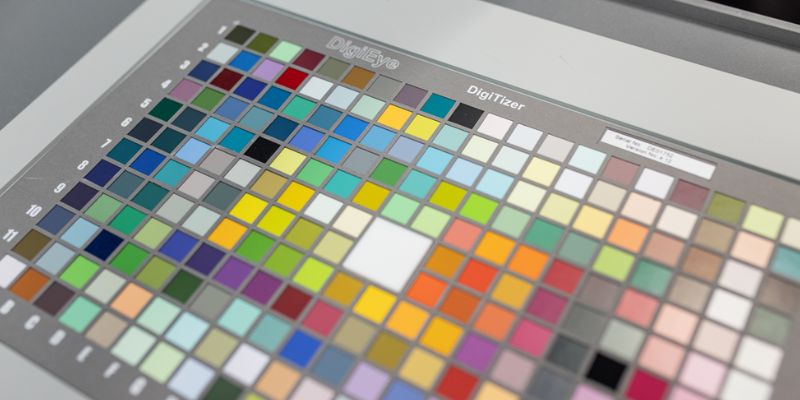
At LITAC, colour research bridges science with practical application, spanning studies in colour perception, colourimetry, and user-centred design through to advanced manufacturing solutions. We investigate the mineralogical mechanisms behind colouration and textile dyeing, and assess how digital and environmental colour use influences cognition and user experience.
By integrating sensory science, design thinking, and innovative fabrication technologies, our research delivers a comprehensive understanding of how colour, materials, and design coalesce to enhance product value and human experience.
Colour Chemistry Research
Our colour chemistry research focuses on the design, synthesis, and evaluation of pioneering colorants, targeting essential applications across science and technology. Key areas include:
- Developing environmentally friendly chemistry for textiles and fibrous materials
- Creating advanced photochromic and thermochromic molecules for anti-counterfeit solutions
- Formulating innovative dyes for sustainable textile coloration
- Exploring biological colorants for photo-medical treatments
- Engineering functional organic dyes for nanotechnology products
We also advance textile coloration and finishing by:
- Introducing alternative dyeing and finishing processes
- Improving the sustainability of fibre dyeing and finishing
- Developing methods for efficient dye application and removal
- Utilising natural dyes for textile colouring
- Functionalising fibre surfaces for stain resistance and specialised finishes
- Innovating ink formulations for digital printing and smart textiles
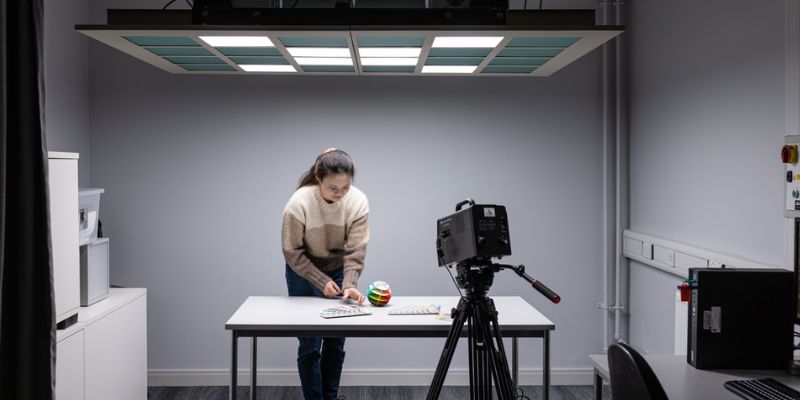
Colour Technology Research
Our Colour Technology research enhances the imaging, measurement, and visual appearance of colour in design and manufacturing. We leverage machine learning and artificial intelligence to extract actionable insights for efficient colour design and decision-making. Additional research includes:
- Analysing consumer aesthetic preferences in interior design for personalised recommendations
- Developing measurement methods for hair, teeth, and skin colour and appearance
- Collaborating with designers on inclusive solutions for colour-blind and low-vision consumers
- Predicting visual attributes from physical material measurements
- Evaluating the influence of light on human behaviour, performance, and well-being in diverse environments
We contribute to global industry standards via the International Commission on Illumination (CIE) and the International Organization for Standardization (ISO).
Colour Physics Research
Colour physics lies at the heart of our mission, combining foundational science with industry-focused practice to improve colour measurement, reproduction, and accuracy across global supply chains. Our work covers light-material interactions, digital imaging, perceptual psychology, and the challenges of maintaining colour fidelity in diverse environments.
A defining strength is our long-term collaboration with VeriVide, providing access to cutting-edge LED assessment systems, DigiEye imaging platforms, and advanced colour mapping software. These resources enable companies to meet evolving standards as industries transition to LED illumination for improved efficiency and low carbon impact.
This convergence of theory, instrumentation, and supply-chain expertise empowers graduates and partners to innovate in fashion, textiles, packaging, digital media, and manufacturing.
Digital Innovation and Artificial Intelligence
We lead digital colour innovation by combining rigorous scientific methodology with advanced computational techniques. Our research extends beyond traditional colour management to address the challenges of measuring textured and biological surfaces, modelling perceptual whiteness and blackness, and exploring the emotional and cultural influences of colour and light.
Through AI and data science, we develop predictive tools, real-time trend analysis, and automated colour decision-making systems for design, manufacturing, and retail applications. Our researchers create explainable machine-learning models that mirror human perception, decode semantic meaning, and anticipate global colour trends.
By merging perceptual science, computational modelling, and collaborative industry partnerships, we help organisations achieve consistent colour quality, enhance digital aesthetics, accelerate product development, and deliver immersive, human-centred experiences. This expertise has supported Future Fashion Factory, our innovation network championing digitally enabled and circular fashion solutions.
Recent Research Outputs
- Lu Y.; Xiao K,; Mizokami Y; (2026), Quantifying Skin Color Appearance in Human Faces and Textured Skin Patches. Skin Research and Technology Volume 51, Issue 2.
- Jiang Y; Guo Q; Wang Y; Cheung V; Westland S; Han J; Zong X; Guo Y; Wang D (2025) Colouration mechanism of chrysoprase: insights from colourimetry, spectroscopy and mineralogy. RSC Advances, 15, (42), pp. 34926-34938.
- Saleh O; Hein S; Westland S; Maesako M; Tsujimoto A; Michalakis K (2025) Classifying the Natural Tooth Color Spaces of Different Ethnic Groups. Color Research & Application, 50, (5), pp. 478-486.
- Bortolotti A; Cheung V; Yu L; Rhodes PA; Palumbo R (2025) Decoding Color Perception: An Eye Tracking Perspective. Journal of Sensory Studies, 40, (2).
- Jiang A; Foing BH; Schlacht IL; Yao X; Cheung V; Rhodes PA (2022) Colour schemes to reduce stress response in the hygiene area of a space station: A Delphi study. Applied Ergonomics, 98, pp. 103573.
- Gazit T; Tager-Shafrir T; Zhong H-X; Hung PCK; Cheung V (2025) The dark side of the interface: examining the influence of different background modes on cognitive performance. Ergonomics, ahead-of-print, (ahead-of-print), pp. 1-14.
- Sanad RA; Cheung V (2025) Effects of colour attributes on textile products’ perceived value. International Design Journal.
- Shi Y; Taylor LW; Kulessa A; Cheung V; Sayem ASM (2024) Re-engineer apparel manufacturing processes with 3D weaving technology for efficient single-step garment production. iScience, 27, (8), pp. 110315.
- Tian T; dos Santos Lonsdale M; Cheung V (2024) Visual instructions for writing Chinese for beginners. Information Design Journal, 29, (1), pp. 36-54.