
University of Leeds Research: Catalysts for Colour Change
Colour is not just visual but a dynamic, context-dependent phenomenon that touches upon every stage of design, technology, and production. Humans perceive colour differently depending on context, digital technologies reproduce it inconsistently, and supply chains often introduce further complexity. Therefore, at the University of Leeds, it is essential that colour is taught, researched, and applied as a holistic discipline: by integrating foundational science, perceptual psychology, and practical design, we are better able to equip students, researchers, and industry partners with the skills to understand colour more broadly, helping to address real-world challenges by way of innovative solutions.
Colour is simultaneously scientific, artistic, commercial, and social. Navigating its complexity requires collaboration, an evidence-based methodology, and a deep appreciation of both tradition and contemporary practice. In this post, we examine some of the University of Leeds’ recent research outputs that concern colour, spanning digital imaging, sustainable chemistry, manufacturing, and human-centred design.
Sustainable Polymer Science
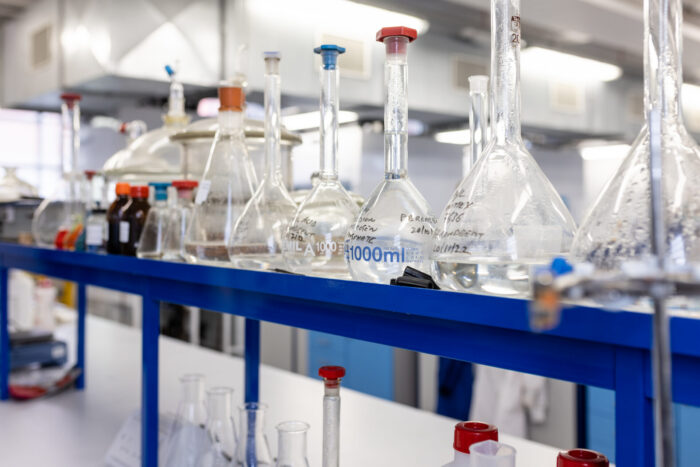
At the University of Leeds, it is essential that sustainable polymer chemistry and advanced polymer materials are taught, researched, and applied as a holistic discipline. Integrating foundational science with practical design allows researchers to better equip industry partners with the skills to address real-world challenges through innovative solutions.
A significant area of this research focuses on the synthesis of intelligent, stimuli-responsive materials for targeted medical treatments. For instance, recent advancements include the development of poly(amino acid) synthesis from 2,5-diketopiperazines, specifically designed for acid-actuated drug release. Alongside this, a research team comprising of Dr. Paul Thornton, Professor Nicholas Warren and Anna Morrell has successfully pioneered the production of polysarcosine-containing nanoparticles through ring-opening polymerisation-induced self-assembly (ROPISA). These breakthroughs demonstrate how fundamental polymer chemistry can be harnessed to create sophisticated, nano-scale vehicles capable of transforming therapeutic delivery.
Beyond targeted therapies, the research team is making vital contributions to the development of advanced structural biomaterials and sustainable chemical processes. The team has engineered enzyme-responsive porous scaffolds via the electrospinning of polyalanine, offering exciting new avenues for tissue engineering. Furthermore, an efficient thermal deprotection strategy has been established for synthesising polylysine adsorbents, directly aligning with the University’s focus on sustainable chemistry.
Alongside this, complementary research led by Professor Giuseppe Tronci has introduced a photodynamic, UV-curable, and fibre-forming polyvinyl alcohol (PVA) derivative, yielding a highly processable material with staining-free antibacterial capabilities.
Ultimately, this body of work demonstrates how foundational science and practical design come together to ensure that chemical innovations are highly functional, sustainable, and commercially viable. This underscores the vital role of polymer science in addressing societal challenges and highlights the University of Leeds’ enduring leadership in applied scientific research.
Sustainable Extraction of Photosynthetic Pigments from Spirulina

A research team comprising of The School of Design’s Dr. Natalia N. Sergeeva, Dr. Shorog Alotaiby, and the School of Food Science and Nutrition’s Dr. Christine Bosch and Dr. Xiao Zhao has developed a water-based extraction method that efficiently isolates blue, green, and yellow photosynthetic pigments from Spirulina, enabling a more sustainable production of natural colorants for industrial applications.
Spirulina is a commercially important cyanobacterium that is rich in natural pigments, including blue phycocyanin, green chlorophylls, and yellow carotenoids. Extracting all three pigments from the same batch has traditionally proved challenging as traditional extraction methods favour one pigment while discarding others.
The research team developed a water-based extraction method combined with mechanical and non-mechanical cell disruption techniques. Simultaneously isolating carotenoids, chlorophyll derivatives, and phycocyanin in high yield. Notably, the approach significantly improves recovery of green chlorophylls, which are often overlooked, and allows their conversion into more stable derivatives suitable for antioxidant and cellular activity testing. Compared to conventional acetone extraction, the water-based method delivers up to 69% higher chlorophyll yields while being safer, more sustainable, and cost-effective.
By enabling simultaneous, high-yield isolation of multiple pigments, this method supports industrial applications in food, cosmetics, pharmaceuticals, and biofuels, where natural colorants with health-promoting properties are in demand. Moreover, the approach minimises waste and reduces exposure to toxic solvents, resulting pigment extraction that best aligns with green chemistry principles.
Inclusive Imaging and Colour Representation: TECNO
A recent study from the University of Leeds (comprising a research team of Dr. Yan Lu, Professor Kaida Xiao, as well as Chiba University’s Dr. Yoko Mizokami) explored how observers of different ethnicities perceive facial colour compared to colorimetric values and how faces can appear lighter and less vibrant than how instruments record. By studying observers of different ethnicities, the team developed a practical framework to quantify facial colour appearance accurately.

The study also uncovered fascinating nuances: Caucasian observers tended to lighten faces more in perception, whereas Chinese observers reduced chromaticity, and the type of stimulus, face or skin patch, significantly influenced these shifts. Despite these perceptual differences, simple models based on CIELAB averages captured over 95% of the variation in matched colours, offering a robust, practical framework for quantifying facial colour appearance. These insights are already shaping inclusive imaging technologies, helping cameras, apps, and digital tools represent all skin tones more faithfully. Science meets real-world impact, bringing everyone into focus.
Professor Xiao has also partnered with TECNO, a global smartphone brand championing inclusive camera technology, to improve the accurate representation of people of all skin tones in mobile photography. Historically, colour calibration and rendering technologies have been biased towards lighter skin tones, often resulting in overexposure or desaturation for people with darker skin. This collaboration applies decades of Leeds-led research in colour perception, imaging science, and skin tone analysis to strengthen TECNO’s multi-skin tone imaging system and deliver more true-to-life, inclusive portraits.
Collaborations such as these highlight the importance of academic-industry partnerships in meeting societal needs and demonstrates how colour research at Leeds directly shapes inclusive digital technologies used by millions of people worldwide.
Sustainable Colour Chemistry and Commercial Impact: Keracol
LITAC’s colour research also underpins advances in sustainable colour chemistry, exemplified by Keracol Ltd, a University of Leeds spin-out co-founded by Professor Richard Blackburn and Professor Chris Rayner. Keracol translates green chemistry research into high-performance, plant-based colourants and actives for applications ranging from textiles to personal care.
A notable collaboration between the University of Leeds, Keracol, and Aveda (Estée Lauder Group) has delivered pioneering research into hair colour chemistry, published in Heliyon. By adapting analytical techniques originally developed for historic textile dyes, the research team developed a new molecular-level method to study how dyes interact with different hair types and textures.
Using advanced solvent extraction and high-performance liquid chromatography (HPLC), the research revealed how fibre properties influence dye retention and fading, opening pathways to longer-lasting, less damaging hair colour solutions. This work demonstrates how colour science at Leeds bridges heritage techniques, modern chemistry, and commercial innovation to deliver sustainable, real-world impact.
World-Leading Colour Measurement and Visual Assessment: VeriVide

LITAC houses one of the most advanced colour research environments globally, developed in close partnership with VeriVide, a long-standing collaborator and leader in colour assessment technology. Together, this partnership has resulted in specialist laboratories equipped with LED-based light booths, DigiEye imaging systems, and advanced spectrophotometry.
These facilities enable high-precision colour measurement, visual evaluation, and digital communication across materials, lighting conditions, and supply chains. They support industry partners in addressing colour-critical challenges such as first-time-right colour matching, LED lighting transitions, and waste reduction through improved accuracy and consistency.
By integrating colour physics, perceptual psychology, and digital imaging, LITAC and VeriVide continue to help businesses adapt to increasingly complex global supply chains and regulatory environments, exemplifying how infrastructure investment and industry partnership strengthen the UK’s leadership in colour science and applied innovation.
Colour Research as a Catalyst for Global Impact
Across inclusive imaging, sustainable chemistry, and advanced colour measurement, LITAC’s research demonstrates how perception, physics, and production come together to ensure colour is accurate, inclusive, sustainable, and commercially viable. By embedding collaboration at every stage, from fundamental research to spinout companies and global partnerships, LITAC continues to shape how colour is measured, experienced, and valued across industries. This case study underscores the vital role of colour science in addressing societal challenges and highlights the University of Leeds’ enduring leadership in this critical field.