
Advancing Textile Science: Research Highlights at the University of Leeds
The University of Leeds’ receipt of the Queen Elizabeth Prize for Education recognises 150 years of world-leading textile research and its far-reaching impact.
The award affirms the university’s distinctive ability to translate textile science into solutions that address global environmental, industrial, and healthcare challenges. It highlights how recent interdisciplinary collaboration, industry partnership, and sustained investment in research excellence have helped to position Leeds at the forefront of innovation, reinforcing the significance of the Queen Elizabeth Prize. This post follows on from the first in a series of highlights looking at research outputs in the school, and focusses on textile innovation.
Tackling Fragmented Fibre Pollution and Microplastics

Research in LITAC and the School of Design, University of Leeds, has played a pivotal role in advancing understanding of fragmented fibre pollution, commonly referred to as microplastics. These fibres are now found across aquatic environments worldwide, from polar ice to deep oceans, and textiles are reported to be the third-largest contributor to microplastic pollution.
Supported by an EPSRC-funded project (EP/T025542/15), a multidisciplinary team led by Professor Muhammad Tausif, with Dr. Abdul Jabbar and Alma Palacios-Marín, worked in collaboration with The University of Edinburgh, Gap Inc., The Microfibre Consortium, and LITAC. Palacios-Marín’s cutting-edge work demonstrates the real-world impact research can have, even at the postgraduate (PGR) level. Over four years, this multidisciplinary project integrated textile technology, computational modelling, and tribology to better understand how fibre damage occurs during manufacture, use, and laundering. By combining experimental testing with predictive modelling, the research identified how yarn structures, fabric design, and wet processing stages influence fibre fragmentation. International collaboration, including novel applications of Particle Image Velocimetry with the Pontifical Catholic University of Chile, further advanced understanding of fibre behaviour in aquatic environments. The project has generated a substantial body of peer-reviewed research and continues to inform industry practice and future interdisciplinary work. You can read more about the project here.
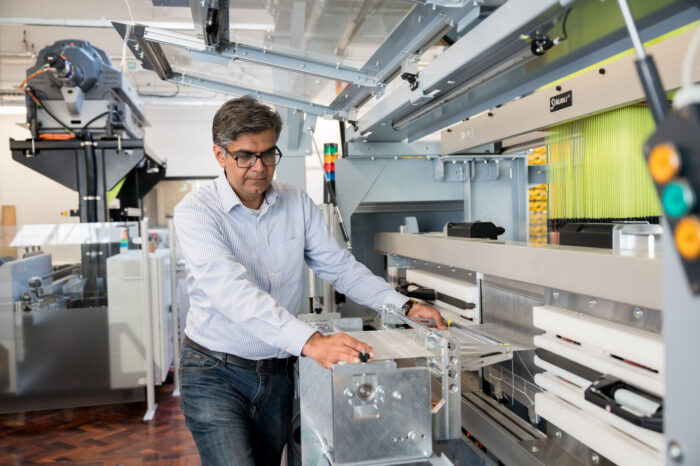
Following the project’s completion, the inaugural Fragmented Fibres Symposium was hosted at the School of Design in March 2025 and the research on these important topics continues. The event showcased nearly a decade of Leeds-led research and brought together designers, engineers, environmental scientists, and industry representatives to address key knowledge gaps and future priorities. Presentations explored textile structure, finishing processes, fibre biodegradation, and modelling techniques, highlighting the need for at-source solutions to reduce fibre release.
Fragmented fibre pollution is a complex, systems-level challenge that demands action at source. Our research at Leeds shows how fibre selection, yarn and fabric structure, and processing choices, supported by robust modelling and close industry collaboration, can significantly reduce fibre release. The Queen Elizabeth Prize recognises the value of translating textile science into practical solutions that protect environments, inform policy, and support a more sustainable future for the sector.
Muhammad Tausif, Head of School of Design and Professor of Sustainable Textile Manufacturing.
Building Circularity through AUTOLOOP
The University of Leeds is a key partner in AUTOLOOP, a major European initiative launched in 2025 to create scalable, closed-loop textile recycling systems. Led at Leeds by Professor Muhammad Tausif, alongside project co-investigators Professor Stephen Russell and Professor Ningtao Mao, the project draws on the university’s strengths in fibre science, recycling technologies, and sustainable manufacturing.
AUTOLOOP addresses the challenge that less than 1% of Europe’s post-consumer textiles are currently recycled in closed-loop systems. Coordinated by Fraunhofer UMSICHT and involving partners across industry and academia, the project is developing advanced automated sorting, chemical recycling, additive tracing and other processes that support Digital Product Passport adoption. By raising these innovations from TRL 3 to TRL 5, AUTOLOOP will help validate circular textile systems under operational conditions. With ambitions to process over one million tonnes of textiles annually by 2050, AUTOLOOP demonstrates how Leeds research contributes to Europe’s transition towards a climate-neutral, resource-efficient textile industry.
Transforming Dyeing through SwitchDye
Innovation at Leeds has also led to the successful spin-out SwitchDye Ltd, based on a breakthrough polyester dyeing technology using 90% fewer chemicals and 40% less water than traditional industrial processes. The spin-out has been supported by The Clothworkers’ Company as well as John Lewis, the Engineering and Physical Sciences Research Council (EPSRC), The Dyers’ Company, the Circular Future Fund, and LITAC.
The resulting innovation enables dyeing and triggered dye removal, significantly reducing wastewater pollution while improving recyclability. Developed through collaboration between Dr. Nathaniel Crompton, Dr. Harrison Oates, Professor Richard Blackburn, and Professor Chris Rayner, SwitchDye exemplifies how multidisciplinary research at Leeds delivers commercially viable, sustainability-driven solutions for the global textile industry.
Textile Innovation for Healthcare
The Clothworkers’ Centre for Textile Materials Innovation for Healthcare (CCTMIH) led by Professor Stephen Russell, and established with support from the Clothworkers’ Foundation, extends textile innovation into healthcare applications. With growing global demand for advanced medical materials, the centre focuses on developing next-generation fibres and textile structures for wound care, diagnostics, and medical devices. As part of LITAC, CCTMIH brings together expertise in textile science, materials science, and smart textile innovation, fostering collaboration with industry to accelerate the translation of research into real-world healthcare solutions.
HyFaCol: From Textile Research to Clinical Impact
One such translation is HyFaCol Ltd, a University of Leeds spin-out addressing one of healthcare’s most pressing challenges: chronic wound healing. Drawing on expertise in biomaterials, textiles, and dentistry, HyFaCol has developed a light-activated, crosslinked collagen dressing that accelerates healing and reduces reliance on antibiotics
Led by Professor Giuseppe Tronci, the work demonstrates how Leeds’ unique research ecosystem enables molecular design, advanced textile manufacturing, and clinical insight to converge, delivering tangible benefits for patients and healthcare systems alike.
A Distinctive Model of Research Impact
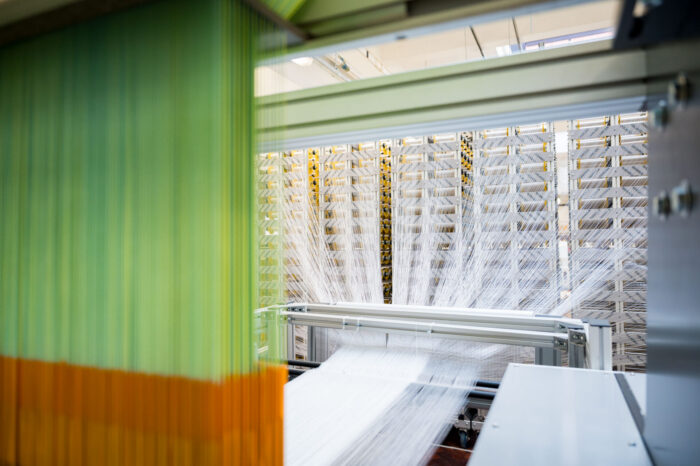
Together, these initiatives illustrate the breadth of interdisciplinary textile research at the University of Leeds as recognised by the Queen Elizabeth Prize. From tackling environmental pollution and advancing circularity to transforming healthcare technologies, textile research at Leeds exemplifies how long-term investment, interdisciplinary collaboration, and industry engagement can deliver lasting global impact.
These research highlights underscore the role of LITAC and the School of Design in sustaining the university’s leadership in textiles, building on heritage, driving innovation, and shaping the future of the sector.